
Home > Blog
The Komodo dragon (Varanus komodoensis) is the largest lizard on Earth and one of Indonesia’s most iconic wildlife species. This prehistoric reptile survives naturally only on a handful of islands in East Nusa Tenggara: Komodo Island, Rinca, Flores, Loh Liang, and Gili Motang. A question often asked by scientists and travelers alike is: why are Komodo dragons only found in Indonesia? Why isn’t such a powerful predator spread across Asia, Australia, or other tropical regions?
The answer is complex. The existence of the Komodo dragon in Indonesia is the result of a long interaction between millions of years of evolution, shifting geological plates, ancient climate change, and the unique structure of island ecosystems. In scientific research, Komodo dragons are a key example of how endemic species form, survive, and persist in isolation.
This article explores the scientific reasons Komodo dragons exist only in Indonesia through the lenses of biogeography, evolution, and ecology.
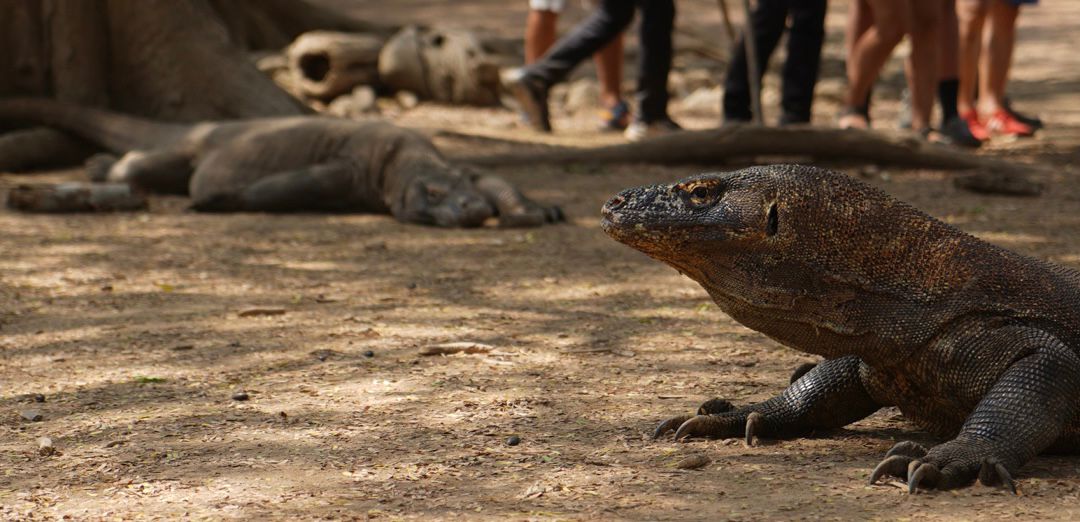
To understand why Komodo dragons are restricted to Indonesia, we must examine their evolutionary history. Komodo dragons belong to the family Varanidae, a group of monitor lizards distributed across Africa, South Asia, Southeast Asia, and Australia.
Modern molecular genetic research shows that Komodo dragons are closely related to giant Australian monitor lizards. DNA analysis suggests their ancestors likely originated in the Australasian region around 4–6 million years ago, during the late Miocene to early Pliocene.
This means Komodo dragons did not suddenly “appear” in Indonesia. They descended from a lineage of giant varanids that migrated from Australia into what is now eastern Indonesia. Once isolated on these islands, their populations diverged genetically and evolved into a distinct species: Varanus komodoensis.
Long-term geographic isolation is the foundation of Komodo dragon endemism.
Komodo dragon habitat lies within Wallacea, a transitional biogeographic region between Asia and Australia. Named after naturalist Alfred Russel Wallace, this region is famous for its sharp faunal boundaries.
Key features of Wallacea include:
It was never directly connected to mainland Asia
It was never fully joined to Australia
It consists of oceanic islands isolated for millions of years
Islands like Komodo, Rinca, and Flores never formed permanent land bridges, even during ice ages when sea levels dropped dramatically. This created extreme geographic isolation.
In evolutionary biology, such isolation promotes allopatric speciation — the formation of new species due to physical separation. Without gene flow from outside populations, Komodo dragons evolved independently and retained unique traits.
Wallacea is often described as a natural evolutionary laboratory, producing many endemic species. The Komodo dragon is its most spectacular example.
In most ecosystems worldwide, apex predators are mammals — lions, wolves, or tigers. But in the Lesser Sunda Islands, the top predator niche is occupied by a reptile: the Komodo dragon.
Island ecosystems differ fundamentally from continents. Small islands tend to have:
Fewer species overall
Lower predator competition
Absence of large mammalian carnivores
Under these conditions, large reptiles can rise to the highest trophic level. Komodo dragons filled this ecological niche, becoming both hunters and efficient scavengers.
The presence of prey animals such as Timor deer, wild pigs, and water buffalo allows Komodo dragons to maintain their massive size. Without large prey, giant predators cannot survive
Komodo dragons are often cited as an example of island gigantism, where island animals evolve larger body sizes than their mainland relatives. However, their case is more nuanced.
Fossil evidence shows giant varanids already existed in Australia before Komodo dragons reached their modern form. Their ancestors were predisposed toward large size. The Indonesian islands then provided ecological conditions that allowed gigantism to persist.
Factors supporting Komodo gigantism include:
Minimal predator competition
Low ecological rivalry
Access to large carcasses
Stable hot climate
Energy-efficient reptilian metabolism
Large size provides ecological dominance, allowing Komodo dragons to control territory and food resources.
Why do giant monitor lizards survive only in Indonesia today? The answer relates to regional extinction patterns.
During the Pleistocene, the Earth experienced intense glacial cycles and environmental instability. Many megafauna species across Australasia went extinct due to climate change and early human activity.
When large prey disappear, large predators collapse through trophic cascades. However, islands can function as ecological refugia — safe zones where species survive after mainland extinction.
The Komodo islands likely served as the final refuge for giant varanids. Their relatively stable environment allowed Komodo dragons to persist while related populations vanished elsewhere
Although Komodo dragons can swim, their distribution is tightly constrained by geography:
Strong ocean currents
Large distances between islands
Limited natural dispersal ability
Specific habitat requirements
Large animals with small populations are highly vulnerable to colonization failure. Even if a few individuals cross water barriers, they may not establish stable breeding populations.
In biogeography, this produces extreme endemism — species confined to tiny natural ranges. Komodo dragons are one of the world’s most famous examples.
Komodo dragons rely on a very specific habitat found in the Lesser Sunda Islands:
Dry tropical savanna
Open monsoon forests
High year-round temperatures
Stable prey populations
As ectothermic reptiles, Komodo dragons depend on environmental heat for metabolism. Cold or excessively humid climates are unsuitable.
The hot, dry savanna ecosystem provides optimal conditions for hunting, digestion, and reproduction. Because this habitat is rare globally, it restricts Komodo distribution.
Today, Komodo dragons are protected within Komodo National Park, a UNESCO World Heritage Site. Conservation is crucial because endemic species with narrow ranges are highly vulnerable to:
Climate change
Habitat loss
Human disturbance
Decline of prey populations
Disease
Modern conservation efforts protect entire ecosystems, not just the dragons. Their survival depends on the integrity of the ecological network supporting them
A common follow-up question is whether Komodo dragons could survive if relocated to another country.
Theoretically possible, but ecologically risky. Komodo dragons require:
Specific prey structure
Large hunting territories
Stable ecosystem interactions
Minimal competition from other apex predators
Introducing a top predator into a foreign ecosystem could cause severe imbalance. The best conservation strategy is preserving them in their natural habitat.
Komodo dragon endemism results from a rare convergence of factors:
Australasian evolutionary ancestry
Geographic isolation within Wallacea
Allopatric speciation
Island gigantism
Regional extinction elsewhere
Islands acting as refugia
Natural dispersal barriers
Tropical savanna specialization
Ecosystem stability in Nusa Tenggara
Modern conservation protection
Komodo dragons are evolutionary relics preserved by a unique meeting of geology, climate, and ecology.
The Komodo dragon is more than an exotic Indonesian animal. It is living evidence of how Earth’s history shapes biodiversity. From ancient migrations and island isolation to gigantism and modern conservation, its existence is an ongoing evolutionary story.
Understanding why Komodo dragons exist only in Indonesia highlights the importance of protecting natural habitats. Endemic species have no backup populations elsewhere. If Komodo dragons disappear from Indonesia, they disappear from the world.
They are not just a national treasure — they are a global responsibility
Come and Visit Komodo dragon with Us Komodo Tour Indonesia
Golden Island Cruises – Komodo’s #1 Trip Partner for Unforgettable Adventures. Book with Confidence with Your Official Komodo Travel Partner and Set Sail to Paradise!
Copyright 2022 © Golden Island Cruises| Powered by PT PULAU MAS ADIDAYA ABADI
Need more Help, Chat us Via What's App
