
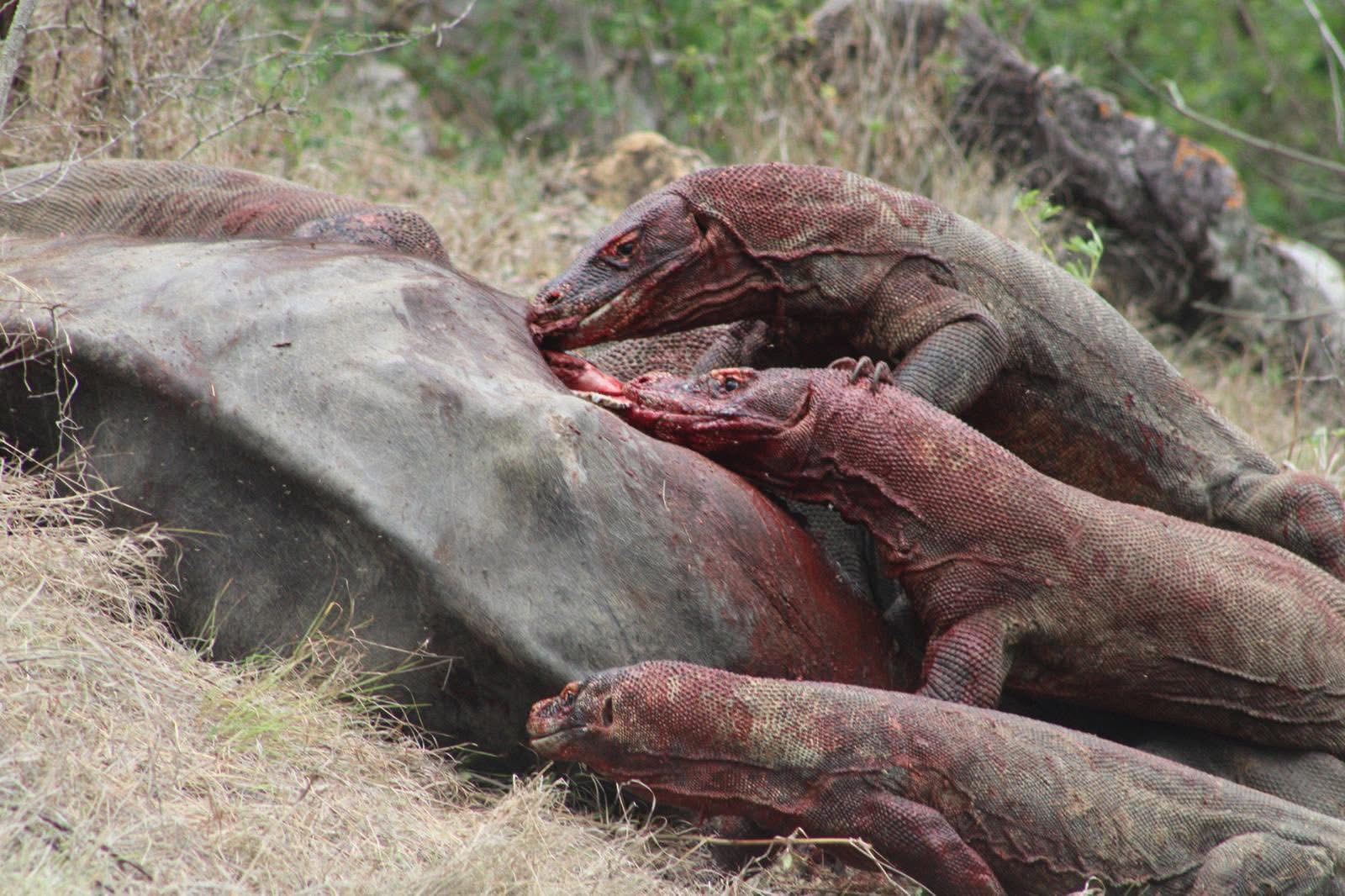
The Komodo dragon (Varanus komodoensis) is one of Earth’s most extraordinary predators. As the largest living lizard species, this prehistoric reptile represents millions of years of evolution and survival. Found only in a small region of Indonesia, the Komodo dragon has become a global wildlife icon and the main attraction of Komodo National Park.
At Golden Island Cruises, we believe understanding Komodo dragons is essential for safe travel, conservation awareness, and responsible tourism. This comprehensive guide covers everything you need to know — from biology and behavior to venom, speed, teeth, lifespan, and human safety.
Komodo dragons are apex predators that dominate their ecosystem. Their biology combines reptilian endurance with mammal-like hunting efficiency.
Scientific name: Varanus komodoensis
Family: Monitor lizard (Varanidae)
Maximum length: Up to 3 meters (10 feet)
Maximum weight: Over 90 kilograms (200 lbs)
Habitat: Savanna, tropical dry forest, coastal scrub
Diet: Carnivorous scavenger and active hunter
Conservation status: Endangered
Komodo dragons use ambush tactics, stealth movement, and chemical sensing through their forked tongue to locate prey over long distances.
One of the most fascinating questions about Komodo dragons is why they exist only in eastern Indonesia.
Komodo dragons evolved in a region that became isolated thousands of years ago. The islands of Komodo, Rinca, Flores, Gili Motang, and Nusa Kode were separated by ocean barriers that prevented large predators from migrating in or out.
This isolation allowed Komodo dragons to:
Grow larger without competition
Dominate the food chain
Develop specialized hunting strategies
The Flores ecosystem provides:
Dry savanna vegetation
Warm tropical climate
Abundant prey species such as deer and wild boar
Low predator competition
These conditions created a perfect natural laboratory for Komodo dragon evolution.
Today, Komodo National Park protects the remaining wild populations. Strict conservation policies prevent relocation or export of this species, preserving its natural habitat.
Komodo dragons are the undisputed giants of the reptile world.
Length: 2.5 – 3 meters
Weight: 70 – 90 kilograms
Tail length: Nearly 50% of total body length
Shoulder height: Up to 80 centimeters
Their muscular limbs and heavy tail allow them to:
Knock down prey
Maintain balance on steep terrain
Defend territory
Fight rival dragons
Male Komodo dragons are generally larger and more aggressive than females.
For decades, scientists believed Komodo dragons relied on bacteria to weaken prey. Modern research has confirmed the presence of true venom glands.
The venom contains anticoagulant and hypotensive compounds that:
Prevent blood clotting
Lower blood pressure
Cause shock
Increase bleeding
Weaken muscles
After biting prey, Komodo dragons track the wounded animal using scent detection until it collapses from blood loss and venom effects.
Unlike traditional predators that rely only on strength, Komodo dragons use chemical warfare combined with physical force — making their bite extremely lethal.
Komodo dragons belong to the monitor lizard family but differ dramatically from other species.
Most monitor lizards grow between 1–2 meters. Komodo dragons exceed 3 meters and carry significantly more muscle mass.
Komodo dragons possess venom glands. Most other monitor lizards rely only on bite force without venom assistance.
Komodo dragons function as apex predators, while other monitor lizards often act as scavengers or mid-level hunters.
Despite their size, Komodo dragons are surprisingly fast over short distances.
Komodo dragons can sprint at speeds up to 20 km/h (12 mph) during ambush attacks.
They do not chase prey long distances. Instead, they rely on:
Camouflage
Sudden bursts of speed
Short ambush attacks
This energy-efficient strategy allows them to conserve strength in hot climates.
Komodo dragon teeth are designed for extreme damage.
Sharp serrated edges
Backward curve for grip
Razor-like cutting surface
Continuous tooth replacement
Their teeth function like natural knives, allowing them to slice through muscle, skin, and bone tissue.
Komodo dragons can consume up to 80% of their body weight in one feeding session, swallowing large chunks of meat whole.
Komodo dragons have long lifespans compared to most reptiles.
Wild environment: 20–30 years
Captivity: Up to 35 years
Their slow metabolism, efficient digestion, and immune resistance help them survive harsh environmental conditions.
Absolutely not. Komodo dragons are protected wildlife.
Endangered species
Highly aggressive predators
Venomous bite
Extremely strong
Require complex habitat conditions
Illegal under Indonesian law
Any attempt to keep Komodo dragons privately is strictly prohibited.
A Komodo dragon bite is considered extremely dangerous.
Deep puncture wounds
Venom injection
Heavy bleeding
Risk of infection
Potential fatal shock
That is why all Komodo dragon trekking activities are supervised by trained rangers. Visitors must never approach or provoke these animals.
Komodo National Park is the only place where tourists can observe Komodo dragons in their natural habitat.
Visitors must:
Stay with licensed guides
Maintain safe distance
Avoid sudden movements
Follow ranger instructions
Never feed wildlife
Komodo dragons represent Indonesia’s biodiversity heritage.
They contribute to:
Global conservation research
Ecotourism economy
Environmental education
Local community income
National pride
Protecting Komodo dragons protects one of the planet’s rarest ecosystems.
Komodo dragons are living relics of Earth’s ancient past. Their size, power, venom, and survival ability make them one of the most remarkable predators still walking the planet.
Experiencing Komodo dragons in the wild is not just a tourist activity — it is a rare opportunity to witness evolutionary history firsthand.
Golden Island Cruises – Komodo’s #1 Trip Partner for Unforgettable Adventures. Book with Confidence with Your Official Komodo Travel Partner and Set Sail to Paradise!
Copyright 2022 © Golden Island Cruises| Powered by PT PULAU MAS ADIDAYA ABADI
Need more Help, Chat us Via What's App
