
Home > Blog
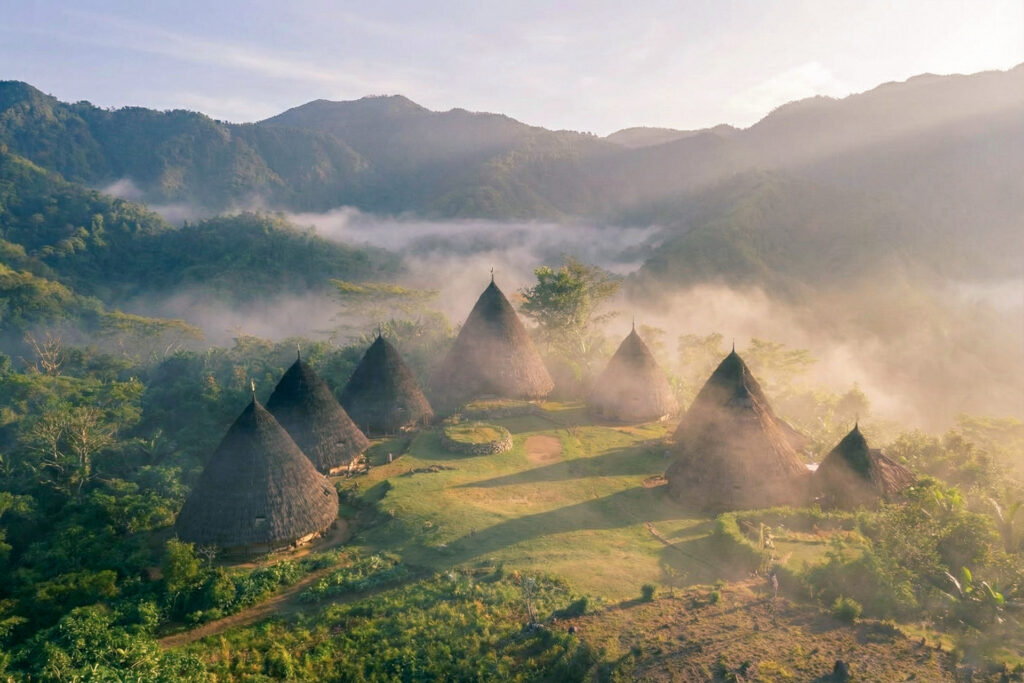
Wae Rebo is a traditional indigenous village located in the mountainous region of Manggarai, Flores, East Nusa Tenggara. It is famously known as the “Village Above the Clouds” due to its unique setting, often shrouded in thick mist and situated at an altitude of approximately 1,200 meters above sea level, offering an exotic display of natural beauty. The village is also distinguished by its seven unique cone-shaped traditional houses known as “Mbaru Niang”, which serve as both residences and ceremonial spaces for offerings. These houses have been recognized as a UNESCO World Cultural Heritage site since 2012, thanks to their authenticity and the community’s strong commitment to preserving them.
Wae Rebo is a highly remote tropical tourism village that can only be reached through a remarkable journey of about 3–4 hours on foot, passing through forests and mountainous trails. The traditions and culture of Wae Rebo are deeply distinctive, reflected in the architecture of the “Mbaru Niang”, traditional thanksgiving ceremonies such as Penti, the skill-based Caci dance, the bamboo game Rangku Alu, and a harmonious communal way of life closely connected to nature. The people uphold strong values of spirituality, gratitude, and respect for their ancestors. Coffee is an important local commodity, while Manggarai ikat weaving is a signature traditional handicraft.
However, due to its almost fantastical cultural atmosphere and its location that has been largely untouched by modernization, stories about the people of Wae Rebo often give rise to myths or unfounded speculation. One such myth is the idea that the area is inhabited by a group of small-statured humans, similar to the depiction of Hobbits in Middle-earth.
In addition to being known as a traditional indigenous village with breathtaking natural scenery, Wae Rebo Village is also often associated with genetic myths surrounding “Homo floresiensis”, commonly referred to as the “Hobbit.” The term “dwarf people,” frequently linked to areas around Flores Island, refers to archaeological discoveries and ancient legends about a prehistoric human species known as Homo floresiensis.
Homo floresiensis (nicknamed the Hobbit) was a small-bodied prehistoric human, earning this name because its average height was only about one meter. Fossils of this small-statured human were discovered by a team of researchers in Liang Bua Cave, a site located not far from the traditional village of Wae Rebo in Manggarai. Although the fossils were found specifically in Liang Bua, stories of these “dwarf humans” are often broadly associated with the Manggarai region, including areas around Wae Rebo, which remain part of the ancient historical mystery of Flores Island.
Furthermore, this belief is also held by residents of Rampasasa Village, located close to Liang Bua Cave. In local lore known as the Rampasasa legend, some community members believe that the people of Wae Rebo are descendants of these ancient small-bodied humans.
The term “dwarf people” associated with the traditional village of Wae Rebo Village is not entirely accurate. In fact, the idea of a group of “hobbits” living in Wae Rebo is purely a myth. The main legend of Wae Rebo tells that the ancestors of the village originated from Minangkabau, led by a figure named Empo Maro. According to the story, Empo Maro fled after being falsely accused, then wandered for a long time and, guided by a dream, eventually settled in Wae Rebo. He later became the founding ancestor of this unique traditional community.
This legend emphasizes the spiritual and physical journey of the ancestors, which brought strong cultural values and identity that persist to this day. These values are closely tied to the surrounding natural environment, which is often covered in mist—reflected in the name “Wae Rebo” (“Wae” meaning water and “Rebo” meaning mist). Contrary to the myth of dwarf humans, oral history states that the present-day inhabitants of Wae Rebo descend from Minangkabau ancestors, particularly Empo Maro, who migrated and settled in the mountainous region of Manggarai.
Based on this legend, the indigenous people of Wae Rebo are not, as many believe, a community of hobbit-like beings. On the contrary, the villagers have normal physical stature and carry out everyday activities just like people elsewhere. The unique stories and lingering mysteries surrounding Wae Rebo have instead become one of its main attractions, drawing both domestic and international tourists.
Beyond its legends, the beauty of Wae Rebo lies in the harmonious combination of the distinctive cone-shaped Mbaru Niang traditional houses set amid the mountains, its nickname as the “village above the clouds” due to its elevation of around 1,200 meters above sea level, the well-preserved Manggarai customs (including rituals such as Penti and the Caci dance), and the breathtaking panorama of tropical forests with cool air and magical morning mist. Wae Rebo offers an authentic cultural experience, jungle trekking activities, and local handicrafts such as traditional weaving and the distinctive Flores coffee.
3 Island Liveaboard offers a relaxed and immersive way to explore the breathtaking waters of Komodo National Park and the Flores Sea. Designed for travelers who want to experience the islands at a comfortable pace, the liveaboard combines the freedom of sailing with the simple pleasure of waking up surrounded by turquoise waters, dramatic landscapes, and untouched tropical scenery.
| Trip Duration | Room Type | Package Type | Price (IDR) / Pax |
|---|---|---|---|
| 3 Days 2 Nights | Private Cabin | Open Trip | IDR 4.450.000 |
| 3 Days 2 Nights | Shared Cabin | Open Trip | IDR 3.450.000 |
| 3 Days 2 Nights | Extra Bed in Private Cabin | Open Trip | IDR 3.000.000 |
